
Photogallery
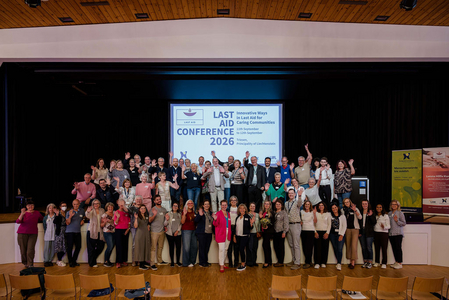
The photos are available for personal use without restriction; if published, please credit them as ‘©Karin Gruber, 2026’.
On 11 and 12 September 2026, the 5th International Last Aid Conference 2026 took place at the Gemeindesaal Triesen. The topic ‘Innovative Ways in Last Aid for Caring Communities’, brought together more than 70 participants from 16 countries.
Keynotes, Posters and Handouts
More Posters and presentation slides will be available soon…
The contribution of Compassionate Communities and Last Aid Courses to Public Health Palliative Care, Georg Bollig
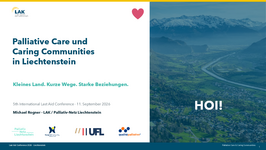
Palliative Care & Caring Community in Liechtenstein, Michael Rogner
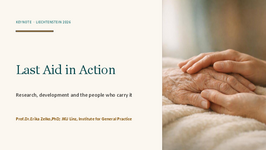
Last Aid in Action: Research, development and the people who carry it, Erika Zelko
Derniers sescours france: Looking back at the 2024 "Tous concernés" ("We are all concerned") communication campaign, Catharine Renard
MAiD in Canada and Last Aid: Part 2, Julie McIntyre
Spirituality in Last Aid Courses: Findings of a Survey among course Instructors in Switzerland, Eva Niedermann
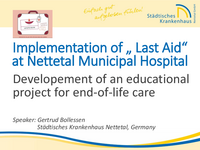
Implementation of "Last Aid" at Nettetal Municipal Hospital: Developement of an educational project for end-of-life care, Gertrud Bollessen, Krankenhaus Nettetal
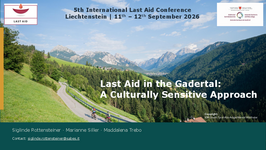
Last Aid in the Gadertal: A Culturally Sensitive Approach, Siglinde Rottensteiner
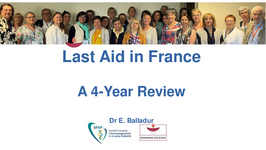
Last Aid in France: A 4-Year Review, Elisabeth Balladur
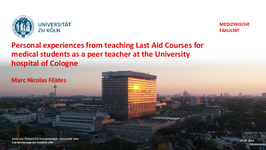
Personal experiences from teaching Last Aid Courses for medical students as a peer teacher at the University hospital of Cologne, Marc Nicolas Földes
Teamhub: digital infrastructure for Last Aid, Mathias Bader
Last Aid organisations in Germany, Austria, Norway, Brazil and Australia run their daily work in Teamhub: instructors, courses, certificates and course feedback, all in one place. Mathias Bader showed it at the conference in Triesen. He has been building it since 2017, out of his own volunteer work in Last Aid.
The software is available for all countries that implement Last Aid. It speaks German, English, Norwegian and Portuguese; further languages are added on request. Developed and hosted in Germany: https://www.teamhub.de/lastaid/en
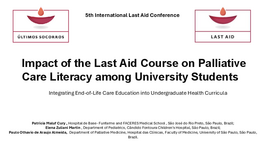
Impact of the Last Aid Course on Palliative Care Literacy among University Students, Patrícia Maluf Cury
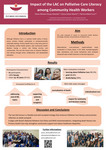
Impact of the LAC on Palliative Care Literacy among Community Health Workers
Paulo Othavio Araujo Almeida; Elena Zuliani Martin; Patrícia Maluf Cury
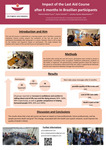
Impact of the Last Aid Course after 6 months in Brazilian participants
Patrícia Maluf Cury; Karin Schmid; Janaina Santos Nascimento
We say thank you
Hospizbewegung Liechtenstein thank all sponsors and supporters, without whose support the conference would not have been possible. Particular recognition goes to the close and committed collaboration with Liechtensteinische Alters- und Krankenhilfe (LAK) and the Private University in the Principality of Liechtenstein (UFL). Through their professional, organisational and communications support, both cooperation partners made a significant contribution to making this international conference in Liechtenstein possible.
The preparation and delivery of the 5th International Last Aid Conference in Triesen were supported by an inter-organisational committee. Its members were Yvonne Odoni and Daniela Ritter (Hospizbewegung Liechtenstein), Michael Rogner and Elisabeth Sommerauer (LAK), and Kerstin Kaiser, Franziska Volland and Rebekka Wehrer (UFL). The Organising Committee was responsible for planning and delivering the conference. In close coordination with the Scientific Committee, it brought together the content-related, organisational and communications requirements and created the framework for international professional exchange in Liechtenstein.
The preparation and delivery of this international conference was a collaborative effort. Special thanks go to all the volunteers who supported us with great commitment in looking after participants and speakers, at check-in, with technical support and with numerous other tasks.
As a cooperation partner, LAK was pleased to contribute its expertise in Palliative Care to the 5th International Last Aid Conference. Its direct involvement in organising an international conference was also a valuable experience for LAK and fully aligned with its commitment to active networking. International networking and exchange with professionals from different countries provide important impetus for the further development of holistic Palliative Care and hospice provision. LAK is committed to ensuring that people in residential long-term care receive professionally competent, compassionate and reliable support, including in difficult phases of life.
As a cooperation partner, the UFL was pleased to support international exchange between research, practice and societal engagement at the 5th International Last Aid Conference by contributing expertise from its various fields. In close coordination with the organisers, the UFL assumed overall operational responsibility for the organisation and delivery of the conference. With Prof. Bernhard Güntert, the UFL was also represented in the keynote programme. The UFL is committed to promoting academic exchange and making science and research accessible to a broad public.
A glimpse inside
President of the Liechtenstein Parliament Manfred Kaufmann welcomed participants on the second day of the conference and highlighted the importance of international exchange in Liechtenstein. He said: ‘This is precisely why we need events like this. They bring together people from different countries and with different experiences. They enable the exchange of knowledge, new findings and ideas – and perhaps the encounters over these two days will also generate new impulses that extend far beyond this conference.’
Franz-Josef Jehle, President of Hospizbewegung Liechtenstein, emphasised in his opening address: He said: ‘Our membership of Last Aid was the decisive factor in bringing this world conference to Liechtenstein. We are particularly pleased that people from numerous countries are coming together here to share experiences and continue working together towards a caring society.’
The conference was musically accompanied by harpist Annelies Brandstätter-Arnold. Following the section focusing on Liechtenstein, a flash mob provided a musical surprise. The idea came from Karla Spiritus and was brought to life by Martin Hanke from the international network ‘Singing Hospitals’, together with conference participants who had travelled to Liechtenstein and teachers from the Liechtenstein Music School. Together, they encouraged the whole audience to join in the singing.
The conference language was English, and all scientific contributions were delivered in English. Participants were able to listen to the interpretation via headphones. A particular link between research and practical implementation was demonstrated during Erika Zelko’s keynote. In connection with a research project by Erika Zelko and Georg Bollig on the development of Last Aid provision for deaf and hard-of-hearing people, her contribution was additionally interpreted into sign language. While Zelko’s English-language presentation was interpreted simultaneously into German, Jill Vogt from the Liechtenstein Behinderten-Verbad interpreted into sign language on the basis of the German interpretation.
· Paulo Othavio de Araujo Almeida, Brazil
· Mara Kouker, Germany
· Eva Niedermann, Switzerland
In addition to the keynotes, the conference provided a platform for current research and practice-based contributions from various countries. These had been submitted through an international Call for Abstracts, reviewed and selected for inclusion in the programme. They were presented either as ten-minute oral presentations or as posters. During the moderated Poster Walk, the authors introduced their topics and projects to participants. Three posters received awards from the jury. Their authors were given an additional opportunity to present their work to the full conference audience in a ten-minute presentation.
A World Café complemented the scientific programme and gave participants the opportunity to discuss and further develop innovative approaches to Last Aid and Caring Communities together.
We thank our donors
Amt für Soziale Dienste
Die Konferenz der Gemeindevorsteher des Fürstentums Liechtenstein
KARL MAYER STIFTUNG
- VP Bank Stiftung
LAST
AID
CONFERENCE
2026
Innovative Ways in Last Aid for Caring Communities
11th September
to 12th September
Principality of Liechtenstein
The 5th International Last Aid Conference 2026 was organised by Hospizbewegung Liechtenstein, Last Aid International, and the Last Aid Research Group International (LARGI) in cooperation with the Liechtensteinischen Alters- und Krankenhilfe (LAK) and the Private University in the Principality of Liechtenstein.
The goal: to present and discuss the latest insights in Last Aid Education and Caring Communities, exploring how these two approaches can complement and strengthen each other.
Experts, educators, researchers, policymakers, professionals, volunteers, and other interested participants from around the world got together to exchange knowledge, experiences, and innovative ideas on end-of-life care and community compassion.
Key topics:
- World Café on Innovative Ways in Last Aid for Caring Communities
- Last Aid Courses for different groups
- Results from international Last Aid research projects
- Combining Caring Communities and Last Aid
- Networking opportunities
Keynote speakers
- Georg Bollig (Germany)
«The contribution of Compassionate Communities and Last Aid Courses to Public Health Palliative Care» - Bernhard Güntert (Switzerland/Liechtenstein)
«Financing Palliative Care, Hospice Care and Last Aid: is there a problem?» - Jason Mills (Australia)
«The Growth and Impact of Last Aid in Australia» - Karin Schmid (Brazil)
«Compassionate Communities and Last Aid in Brazil» - Erika Zelko (Austria)
«Caring till the End – What research teaches us about Last Aid »
Programme
10th September 2026
Pre-Conference meeting of the international Last Aid working group: 12:00 a.m. till 4:00 p.m. (CEST)
Anniversary event of the Hospizbewegung Liechtenstein from 6 p.m.
11th September 2026
Day 1 of the Conference: 9:30 a.m. to 5:00 p.m. (CEST)
Doors Open: 9:00 a.m.
Social Event in the evening.
12th September 2026
Day 2 of the Conference: 9:00 a.m. to 2:00 p.m. (CEST)
Doors Open: 8:30 a.m.
The detailed conference programme is now available.
The official conference language is English. All presentations will be held in English. Simultaneous interpretation between English and German will be available throughout the conference.
Please note: Caring till the End – What research teaches us about Last Aid by Univ.-Prof. Dr. med. Erika Zelko (AT) will also be interpreted into sign language.
Call for abstracts
Authors are invited to submit abstracts on the following themes:
Last Aid in my country
Networks in the community
Compassionate communities
Research project to enhance palliative care in communities
Abstract submission deadline is 29th May 2026.
The organisers will publish only the papers submitted by authors, who will settle their registration fee by 1st June2026.
The presenting author must be registered before 1st June 2026.
The abstract must be written in English.
The abstract body should be structured into four sections: Background, Methods, Results, Discussion/Conclusion.
The abstract must not exceed 300 words.
Tables and figures are not accepted as part of the abstract.
The abstract must be sent to the conference secretary before 30th April 2026 by uploading in Word format on the website of the conference.
The abstract will be reviewed by the Conference Scientific Committee.
The first author will receive further instructions for preparing the poster presentation after their abstract has been accepted. The presenting author will be underlined in the programme and will serve as the contact person for further correspondence.
The organisers will publish only the papers submitted by authors who have paid their registration fee by 1st June 2026.
Upload now
Practical Information
Here you will find practical information about your journey, accommodation, the conference venue and other useful tips for your stay in Liechtenstein and Payment from Non European Countries.
Registration is closed. We look forward to seeing all our participants in Triesen.
Registration deadline : 24th August 2026
- Regular: EUR 150
- Students: EUR 120
The official language in Liechtenstein is German. However, most people in Liechtenstein have at least a basic proficiency in English.
Conference Language
The official conference language is English. All presentations will be held in English. Simultaneous interpretation between English and German will be available throughout the conference.
We suggest the following options based on their proximity and prize:
- Youth Hostel Liechtenstein (Schaan-Vaduz, 25 min via public transport, starting at CHF 69.50 person/night)
- Haus Gutenberg (Balzers, 18 min via public transport)
B&B HOTEL Liechtenstein-Eschen (Eschen, 35 min via public transport, for single use CHF 120 room/night, for double use CHF 150 room/night )
Book with the following Tag: «Last-Aid 2026». The conference contingent will be available until June 2026.
Other hotels and guesthouses can be booked through tourismus.li or platforms such as Airbnb.
Considering the various options for arriving by train, the following locations are also recommended: Feldkirch (AT), Sargans (CH), Buchs (CH). We also recommend to explore private accommodations. They offer a wonderful opportunity to get to know the region and its people.
If you are able to extend your stay, we recommend the charming holiday villages and mountain regions of Liechtenstein – an ideal place to relax and enjoy the beauty of the Alps after the conference.
List of accommodations (download)
- By plane: Switzerland: Zurich (ZRH) https://www.flughafen-zuerich.ch/en/passengers and St. Gallen-Altenrhein (ACH) peoples.ch. Germany: Friedrichshafen (FDH) https://www.bodensee-airport.eu/en/
- By train: The best train stations to arrive at are Feldkirch HBF (Austria) or Buchs or Sargans in Switzerland. From there, you can take a bus to Triesen and the UFL (Triesen Sonnenkreisel), https://liemobil.li/en ; https://www.sbb.ch/en
- By car: A vignette is required to use the motorways in Switzerland and Austria (coming from Germany via Hohenems). There are no customs borders between Switzerland and the Principality of Liechtenstein.
You can reach Triesen without using the Swiss motorway via Feldkirch (A). Please think of our environment and use public transportation.
- Visa Requirements: Schengen visa applies for most countries. The conference secretary proviceds letters of invitations, after registering on the conference webseite.
- Currency: Swiss Franc (CHF)
- Time Zone: Central European Time (CET), Central European Summer Time (CEST)
- Emergency Number: 112 (for all emergencies)
- Electricity: 230V, 50Hz, plug type C and J
Triesen Community Hall, Dröschistrasse 4, FL-9495 Triesen
If you are transferring the conference fee from outside the SEPA payment area, please use an international SWIFT bank transfer.
Bank details:
Bank: VP Bank AG
Aeulestrasse 6, 9490 Vaduz, Principality of Liechtenstein
BIC/SWIFT: VPBVLI2X
Recipient: Hospizbewegung Liechtenstein
Haus St. Mamertus, Landstrasse 317, 9495 Triesen, Principality of Liechtenstein
IBAN: LI57 0880 5503 2865 8024 8
Payment reference: Last Aid Conference 2026
Depending on your bank and country, you may be asked to enter the recipient's full legal name and address as well as the purpose of the payment. Please use the information provided above.
Bank clearing number: 8805


